Fun · AI video class · El Paso
Make a film with AI. Plan it before you render it.
A hands-on class in five parts: story, character, a shot plan written with Claude, permission, and the best part, which is putting your character in a scene with someone else's. Everyone leaves with a finished short film.
Sound familiar?
- The first image was great. In the second shot, it was a different person.
- You spent your credits finding out what the tool can't do.
- It looks like AI because nothing in it was decided.
The class
Five parts, one afternoon.
- 0:00Story
One sentence and three beats, before any image exists.
- 0:20Character
A character card, a turnaround sheet, and a lock that keeps the face from drifting.
- 1:00Plan with Claude
A shot plan timed beat by beat. Then, and only then, render.
- 1:45Permission
Whose face, whose place, whose idea. Real people, and people who don't exist.
- 2:05Collaboration
Trade characters, share a scene, and join the class lineup.
- 2:45Screening
Everything made in the room, played on the big screen.
Part 01 · Story
Start with one sentence.
Every film on my reel started as a line of text, before a single frame was made. The class starts the same way: a logline, then three beats. What happens, what turns, and how it ends.
- A grandmother's exoskeleton comes online, piece by piece.Legs · suit-up reveal
- He didn't ask for it. He hasn't taken it off.Still in Office · character reveal
- Ten characters at one casting call. The judge looks up once.The Audition · lineup
The sentence tells the camera what to do. A chimp mugging in a crown is a greeting card. A chimp putting up with one is a portrait, and every shot in Still in Office follows from that difference.
Part 02 · Character design
Lock the character before you shoot.
A character card has two halves: who they are, and what they look like. The look gets one small, specific detail the model can hold on to, like a chipped front tooth or an old burn scar on the forearm, plus one prop. Then the card becomes a four-panel turnaround sheet: front, three-quarter, profile and close-up. Every shot after that uses the sheet as its reference.


Vague words get generic pictures. Anise's first suit came back with a spiked helmet and blade fins, because the description left room for them. The next three suits each got one specific anchor, a single crest or fin from a named animal, and all three came back clean.
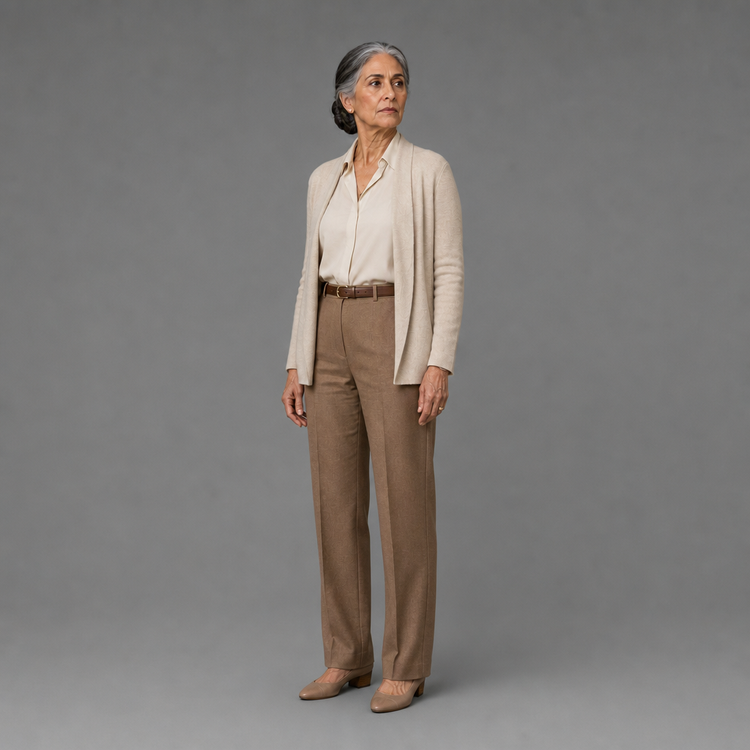
Models drift even with a reference image attached. So every card ends in a short paragraph called the lock, which gets pasted into every prompt with that character in it. Saying the same details every time is what keeps the face from changing.
From the card · Anise Baca, Legs
ANISE BACA (CIVILIAN) — LOCK: Mexican-American woman, mid-60s, trim and upright posture, deep-set dark eyes, dark brown hair silver-white at the temples in a low chignon, small chemical-burn scar inside left forearm, cream/camel/soft-grey tailoring. Use the attached reference sheet as strict visual anchor. No redesigns.
Part 03 · Plan with Claude
Plan it with Claude. Then render.
Claude turns the sentence and the card into a shot plan. Each beat gets a start and end time, a first and last frame, what the camera does, what you hear, and what must not change. Problems show up on paper, where fixing them is free, instead of in the render queue, where every try costs credits.
From the plan · Legs, the running take
0.00–1.00s   Static hold. Civilian Anise.
1.00–11.00s  One continuous generation: running + full assembly.
11.00–13.00s Hero hold on the final frame.
13.00–15.00s LEGS title card.

Core prompt, step 2 of 5: "Leg struts snap into place along the outer thigh and shin mid-stride, locking at hip, knee and ankle with a flash of pale-blue light as each seats. Real rehabilitation-exoskeleton hardware, never wing-like or blade-like."
What the plan caught before any credits were spent
- 01One take, longer than the tool allows
The Legs run is one unbroken ten-second take, and most video tools stop at eight to ten seconds per generation. The plan said so up front: render at the tool's maximum and extend from the last frame, or split the take at the torso plating.
- 02Shots too short to render
An earlier Legs cut had three beats under two seconds, shorter than most tools will make. The fix went into the plan: render at the minimum, then trim from the front so the end pose still matches the next shot.
- 03Too much in one shot
An Amigo Man teaser packed a voiceover, a power cut and a spoken line into two seconds. The plan flagged it, and the establishing shot gave up a second to make room.
- 04Two faces in one close-up
Two locked characters sharing a close-up tend to blur into each other. You test that on a cheap shot before you build a scene around it.
Part 04 · Permission
Whose face is it?
Every card I build opens with one line: real person, yes or no. The answer sends the character down one of two roads.
A real person
Face-lock tools learn from twenty or more photos of one person, so that person is now in your film. Your own face is fine. Anyone else needs to give you a written yes that says where the film will be shown. Famous faces are off the table.
Someone who doesn't exist
Built from words, not photos. A reference photo can set a style, a wardrobe or a neighborhood. It can't be one real person with the name changed. Invented means invented.
It isn't only faces
- 01Brands and mascots
Amigo Man is El Paso's real civic mascot, and he has an owner. My Amigo Man films stay parody. A paid version would start with a license conversation with that owner.
- 02Places and art
The Audition was shot against a real El Paso wall with murals by real artists. The frames invent their own art and show no readable words. The photo sets the light and the geometry, nothing else.
- 03Who made what
Each project keeps a ledger. Every idea is marked as the author's, or as an AI proposal waiting for the author to pick it. Nothing goes into the film until a person chooses it.
The class teaches good practice, not law. Anything headed for commercial use gets a lawyer's read first.
Part 05 · Collaboration
Your character meets mine.
This is the fun part. Once everyone in the room has a locked character, the room trades. Two people put two cards in one scene and plan it together. Beto, from Legs, challenges Natalia to a game of HORSE on a court under the interstate. Natalia and Bertha play tug-of-war with a rope that isn't there, and pull hard enough to make a tornado.
The rules of the trade
- 01You keep your lock
Nobody redesigns your character but you.
- 02The plan names every card
Whose character is whose, in writing, in every shared shot.
- 03The ledger keeps the credit
Who came up with the scene, the gag, the ending.
The finale: the lineup.
The Audition put ten characters from different projects against one wall, each with a paper number pinned to their chest. A chimp in a costume crown walks the line while each one performs a single trick. He looks up only once. The class ends the same way. Every character in the room gets one beat in the lineup, and we screen it together before anyone goes home.
What everyone leaves with
Proof, not a certificate.
- 01A character
The card, the turnaround sheet and the lock, ready to use again.
- 02A shot plan
Written with Claude, beat by beat. The method works on the next film too.
- 03A short film
10 to 15 seconds, made in the room.
- 04A shared scene
Made with a partner, both characters intact.
- 05A place in the lineup
The class film, with everyone in it.
- 06A permission checklist
One page: whose face, whose place, whose brand, who made what.
Format
No experience required.
Everything is taught from the interface down: what to type, what to click, what to keep. Bring a laptop. The class uses Claude for planning and one image-and-video tool for rendering.
Book the class
